
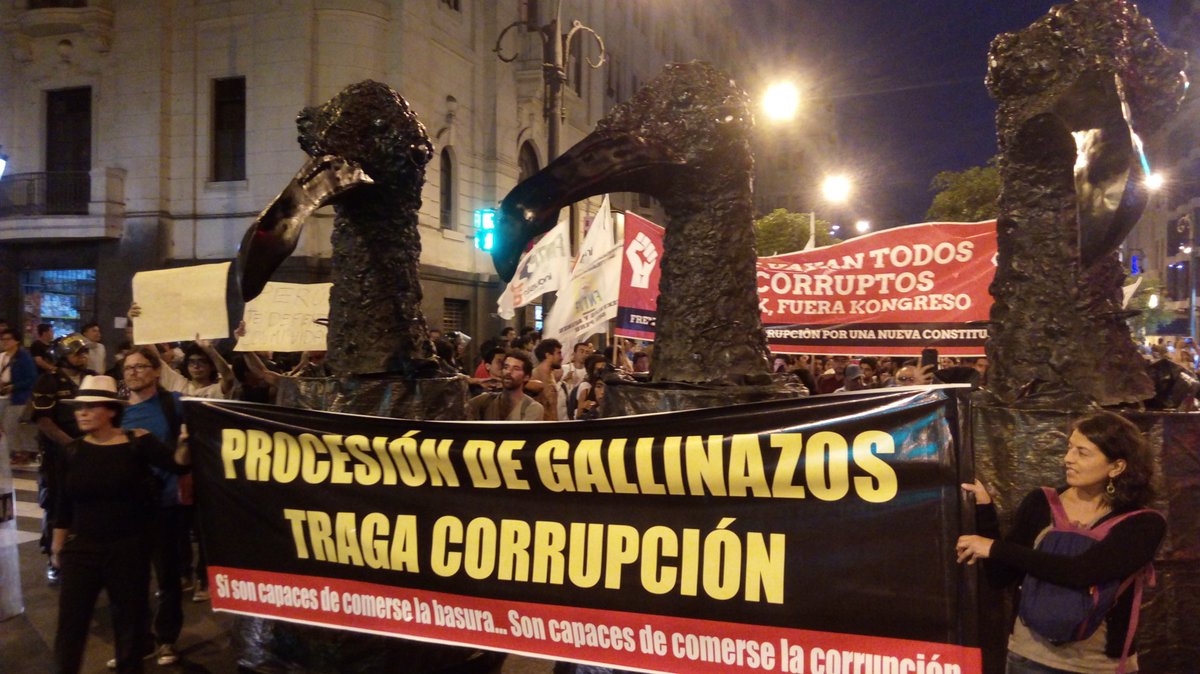
Corruption ranks among Peruvians’ top concerns, only second to insecurity, as the country heads into a general election on Sunday.
Since 2016, Peru has suffered from severe political instability, with repeated graft scandals contributing to the succession of eight different presidents. The country currently ranks 130 out of 182 on Transparency International’s corruption index.
To get an idea of how some of the 35 candidates for president may tackle corruption if elected, Peru Reports spoke with Dr. Joseph Pozsgai-Alvarez, a Peruvian political scientist specialized in anti-corruption and public integrity from Osaka University.
Populist promises and unrealistic plans
Candidate Rafael López Aliaga, the former far-right mayor of Lima — himself under investigation for alleged corruption –has proposed to raise jail sentences to life imprisonment for officials found guilty of corruption.
According to Pozsgai-Alvarez, “That is populist rhetoric.” He said that besides the constitutional challenges of López Aliaga’s proposal, “it is difficult to believe any court would hand a life sentence for anything other than the most egregious cases of corruption given the evidential burden.”
In other words, the life sentence would probably never effectively be applied, according to the professor.
“The result is that Lopez Aliaga will earn some political points without actually accomplishing anything,” he added.
Lopez Aliaga, who ranked in the top of the polls for months before plunging last week, also pledged to cut down the number of ministries to reduce the chances of dishonest practices.
The proposal is a “comical” proposition, on par with Wolgang Grozo’s idea to use a lie detector for senior officials, according to Pozsgai-Alvarez.
Read more: What to expect from Peru’s general election on Sunday
A runner-up in the last three elections, right-wing candidate Keiko Fujimori, the daughter of former dictator Alberto Fujimori, has promised to strengthen the existing institutions such as the National Authority of Transparency and Access to Information (ANTAIP), which has operated since 2017 without relative success.
The ANTAIP is a body appointed by the Minister of Justice and designed to advise policy on transparency, supervise institutions, potentially propose sanctions, and launch sensibilization campaigns.
Pozsgai-Alvarez believes that reimagining rather than fortifying the agency is the solution. “The National Authority needs to be reinvented as a constitutionally autonomous organization, which is no small affair,” he said.
“Once an agency exists, it is difficult to significantly transform it, so I don’t think there will be sufficient political capital to incentivize actors in this direction.”

Fujimori, who was formerly indicted in the regional Odebrecht corruption scandal, announced she would also ban companies already sanctioned from obtaining public contracts.
Whilst “politically doable”, Pozsgai-Alvarez believes this measure “requires an agency sufficiently autonomous to carry out that duty.”
The scholar added: “In a situation of state capture, which Peru is ripe for, it is more likely that we would see such power being used to punish corporations for failing to comply with political directives.”
Peru’s former Central Bank director, Alfonso López-Chau, has put forth in his candidacy an initiative that would emulate Mexico’s large anti-corruption system layered across several institutions.
The authority would be politically autonomous and potentially composed of a prosecutorial body with investigative powers working with the administrative court, an audit administration and a civilian watchdog.
In Pozsgai-Alvarez’s opinion, the Mexican example proved to be an “utter failure”, and recreating it in Peru remains unrealistic.
Carlos Alvarez, a comedian known for impersonating politicians and who is running on a strict, security-centered platform, proposed a plan to build a new state agency solely dedicated to anti-corruption.
The electorate should remain “always suspicious” of promises to launch new specialized agencies, Pozsgai-Alvarez said.
According to the scholar’s work, three similar attempts to create new agencies since 2000 have failed due to intentional structural weaknesses and pushback from high-profile politicians when investigations were launched against them.
No improvement without stability
While Pozsgai-Alvarez believes that “several candidates may also honestly have good intentions,” their general inexperience in both state administration and party politics will make it “unlikely they will be able to keep integrity at the center of the next administration.”
He argues that the constant cycling of presidents has historically hampered any chance of tangible change when it comes to fighting corruption.
“What we’ve been missing over the past decade is sufficient political stability to allow actors to invest sufficient resources in viable integrity measures,” he said.
“Stability is not enough, but it is certainly necessary.”