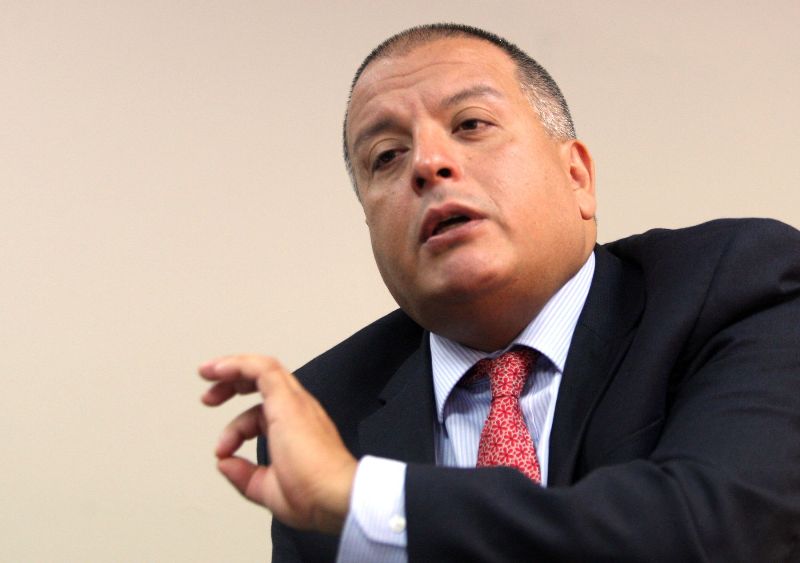

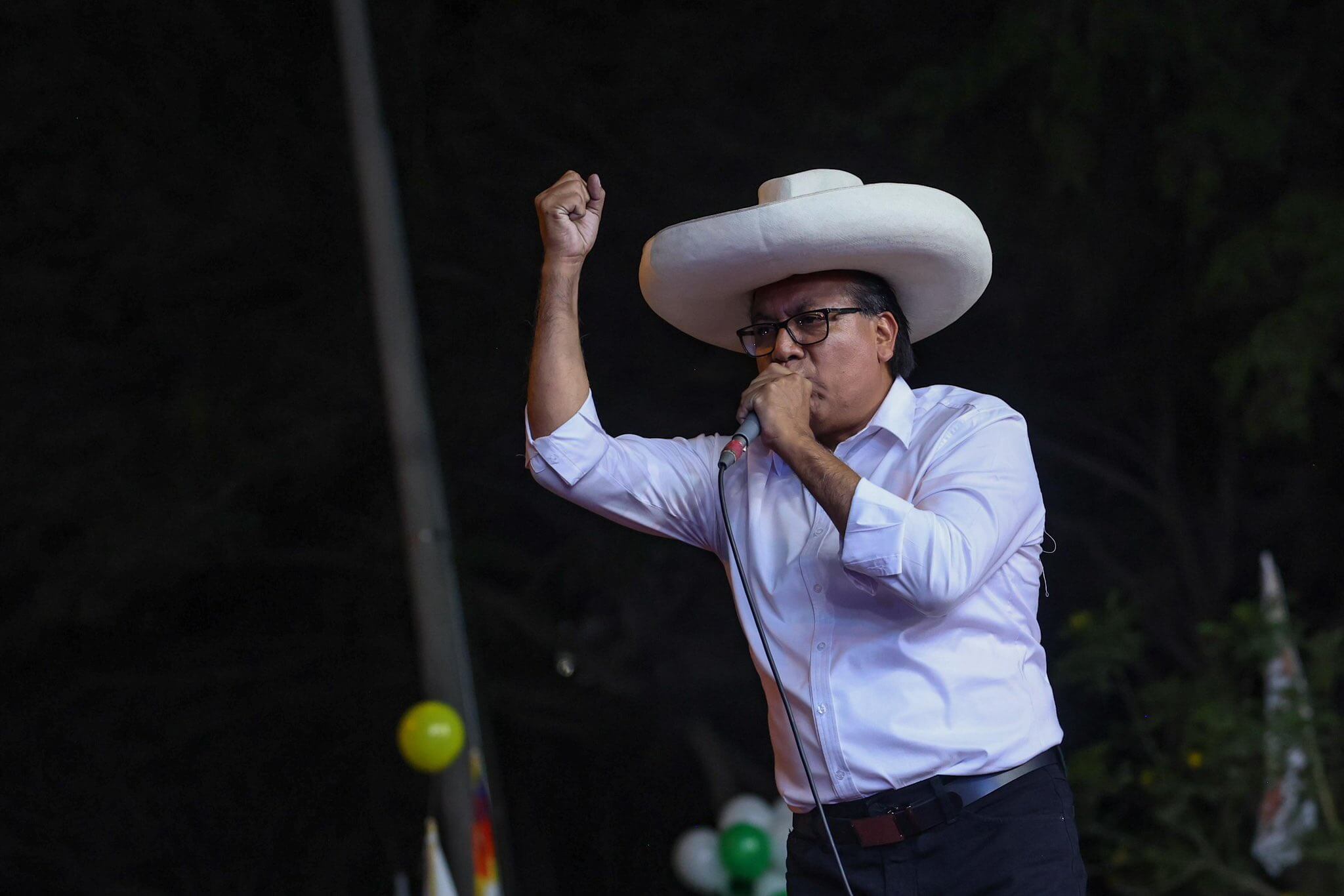
Roberto Sánchez, a left-wing congressman and former minister, campaigns wearing a hulking straw hat — one that is not his own.
It once belonged to Pedro Castillo, the jailed former president of Perú, who won the 2021 election against Keiko Fujimori, the conservative daughter of former dictator Alberto Fujimori, whom Sánchez will also face in a runoff election on Sunday.
The hat, along with Castillo, has become emblematic of the grassroots political movement that Sánchez may carry on should he win the highly polarized elections — even as he attempts to soften some of its more radical aspects.
Born in Huaral, a coastal province north of Lima, to a barber and a housemaid, Sánchez shined shoes from age seven to 13. He went on to graduate with a psychology degree from San Marcos University and holds a master’s degree in social policy.
His entire career was built in the public sector including as a congressman, minister of commerce under Castillo, and as president of the Juntos por el Perú (Together for Perú) political party since 2017.
Castillismo, a political movement named for Castillo, has its roots in rural land reform, anti-elitism, and left-wing populism. Some analysts argue that despite its leader’s incarceration for attempting to dissolve Congress in 2022, the movement endures because of the social and economic realities of the country.
“The vote for Castillo and Sánchez does have a real underlying basis. I would not describe it as a protest vote, but rather as a vote born out of desperation and abandonment. It is the vote of Perú’s extremely poor,” Hernán Garrido Lecca, an economist and former health minister (2007-2008), told Perú Reports.
According to Peru’s National Institute of Statistics and Informatics (INEI), 4.7% of Perú’s population — approximately 1.6 million people — lived in extreme poverty in 2025, unable to afford even a basic food basket.
Poverty predominantly exists in rural communities in the Andes and the Amazon regions that remain largely disconnected from the economic and political center of the capital Lima.
“Castillismo does not respond to Castillo as a person, but to what he represents — the protest against Lima’s centralism and the abandonment of the regions,” Catherine Lanseros, a Peruvian journalist, told Perú Reports.
Unlike Castillo, Sánchez has sought to present himself as a more institutional and pragmatic left-wing candidate.
He is better educated, more articulate, and a seasoned politician; he made that distinction clear in last week’s debate, attacking Fujimori and her party, Fuerza Popular, for their role in the country’s political instability in recent years.
In an effort to reassure moderates wary of his leftist policies, in the final days of his campaign, Sánchez presented a 114-page government plan promising macroeconomic stability, respect for the Central Bank’s autonomy, and continuity of free trade agreements.
Whether this represents genuine moderation or a last-minute political strategy remains, for many Peruvians, a defining question.
As Lanseros put it: “No matter how many times he rewrites his government proposal, Sánchez cannot deny his essence.”
Featured image: Roberto Sánchez is running for president of Perú in elections on June 7, 2026.
Image credit: Roberto Sánchez via X.